Guide
What is SEO, and why does it matter?
SEO gets mentioned in every quote and every plan, but rarely explained. Every element that makes it up, why it's worth the cost, and what it saves you over time — all on one page.
What SEO actually is
, search engine optimization, is the ongoing work of making a website easy for Google to , understand, and rank for the specific searches your customers already type in. It spans several distinct disciplines that all feed the same goal: page speed and technical infrastructure so search engines can actually process a site, on-page structure and copy that state clearly what a page is about, content credible enough to earn trust, and external signals like backlinks and reviews that vouch for a site from outside it. None of these substitute for the others. A fast site with no relevant content still won't rank, and great content on a slow, unindexable site never gets seen. Because Google recrawls constantly and competitors keep publishing, none of this is a setting switched on once at launch. It's maintenance that keeps paying off or keeps falling behind, depending on whether anyone keeps doing it after the site goes live.
(search engine optimization) is the work of making a website easy for Google to find, understand, and rank for the searches your customers actually type in — things like page speed, page structure, keyword targeting, and the trust signals search engines use to decide who shows up first.
It's not a one-time setting you switch on at launch. Google re-crawls and re-ranks sites continuously, competitors keep publishing, and search behavior keeps shifting — so is ongoing maintenance, not a checkbox.
Why it matters for your business
matters because it controls whether your business shows up at the exact moment someone is actively looking for what you sell, before they've decided which company to call. Most buying journeys start with a search, not an ad, a referral, or a social post, so a business invisible in search results is invisible at the specific moment intent is highest. The economics are also different from paid channels: an ad stops sending traffic the instant you stop paying for it, while a page that earns a strong ranking keeps bringing in visitors month after month without a fresh spend behind each click, which compounds over time in a way ad spend never does. That's also why SEO tends to pay off less immediately but more durably than paid acquisition, and why skipping it isn't neutral. It's not a missing nice-to-have; it's ceding that search-intent traffic directly to whichever competitor already ranks for it.
Most buying journeys start with a search, not an ad click. If a site doesn't rank for the searches its customers are already making, that traffic goes to whichever competitor does.
Unlike paid ads, organic rankings keep working after the work is done. A page that ranks well keeps bringing in visitors every month without a fresh spend behind each click.
Not just claims — real numbers
Real Google Search Console data from sites we built. No ad spend behind any of it — all organic search traffic.
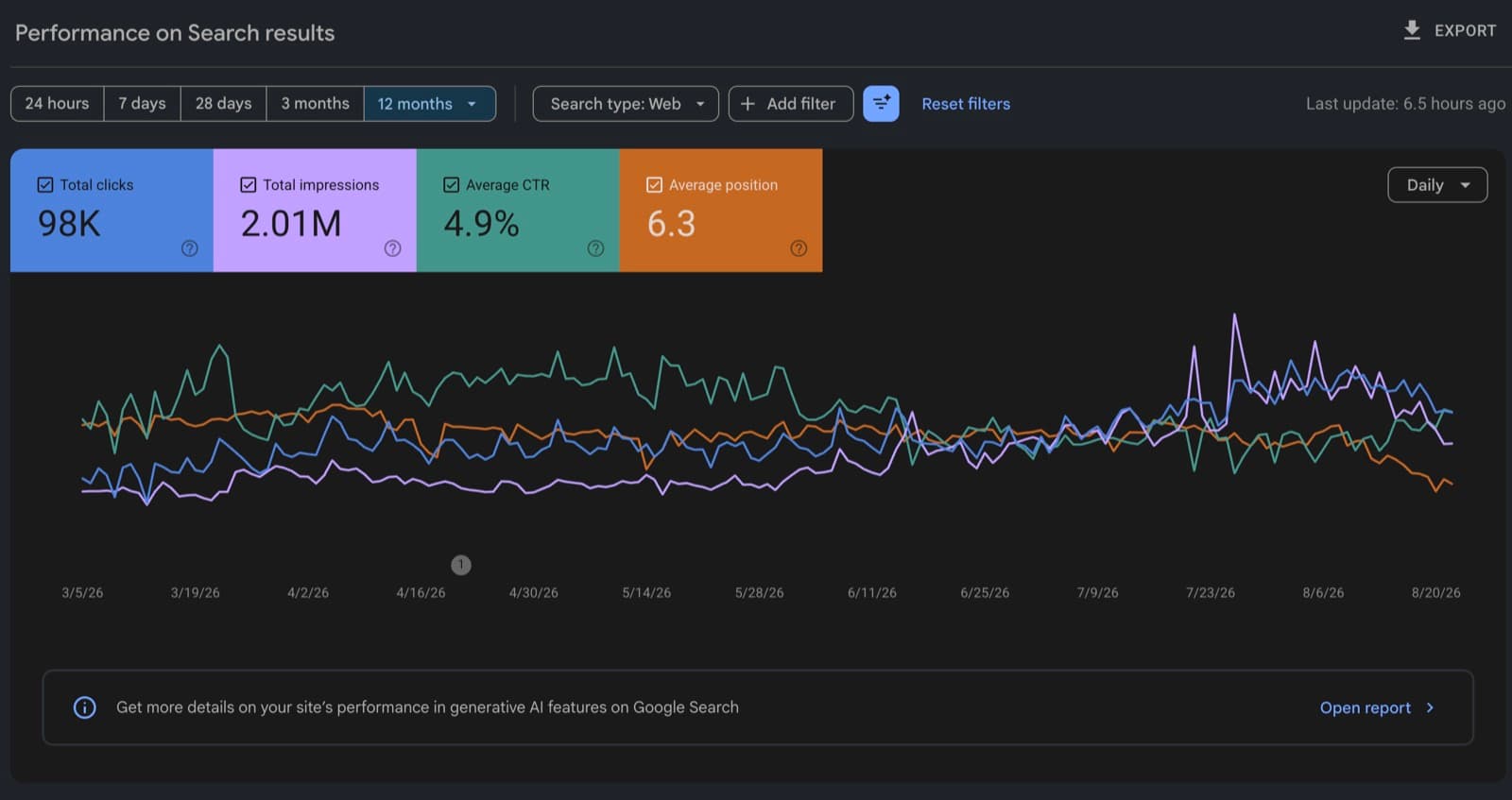
Seoul Homes →Last 12 months
98K
Clicks
2.01M
Impressions
4.9%
Avg. CTR
6.3
Avg. position
About 8,200 clicks a month. At typical real estate paid-search rates ($1-3/click), buying this traffic through ads alone would run roughly $8,000-24,000 a month. This site gets it organically, at $0.
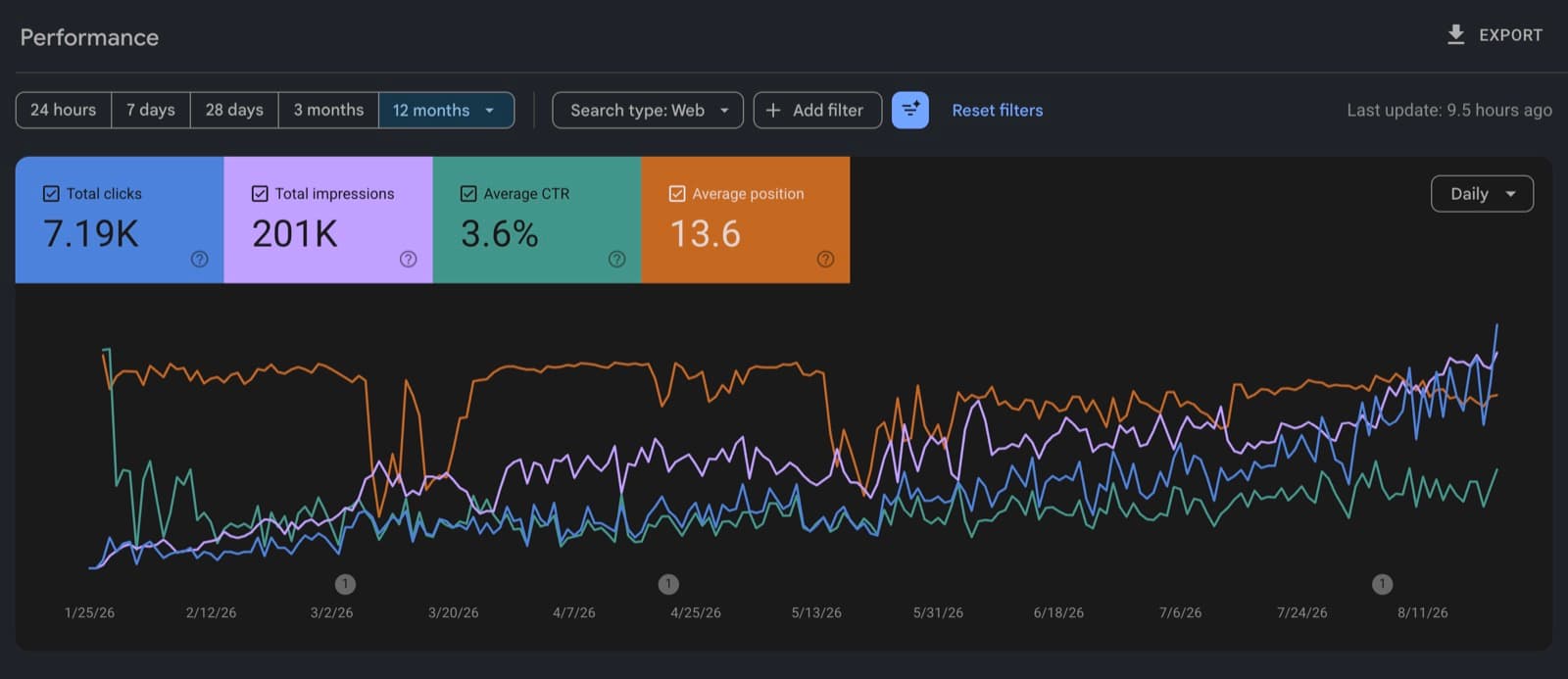
MassageGo →Last 12 months
7.19K
Clicks
201K
Impressions
3.6%
Avg. CTR
13.6
Avg. position
About 600 clicks a month. At typical health & wellness paid-search rates ($0.50-1.50/click), that's roughly $300-900 a month in equivalent ad spend. Organic got it for free.
When you work with us, we share Google Search Console access directly — the same dashboards behind the numbers above. You see exactly how rankings and traffic move, not just our summary of it.
* Cost-per-click estimates reference typical paid search rates for each industry and market; actual bids vary by keyword, timing, and competition.
On-page SEO
On-page is every ranking factor a site owner can control directly inside a single page's own code and copy, as opposed to technical infrastructure or external signals like backlinks. That includes the title tag and meta description that show up in the search result snippet, a heading structure (H1 through H3) that lays out the page's information hierarchy logically, keywords worked naturally into the body copy rather than stuffed in, descriptive image alt text, and internal links pointing to genuinely related pages elsewhere on the site. The underlying goal in all of it is clarity, not manipulation: telling both a search engine's and an actual human reader exactly what a given page is about, quickly enough that neither has to guess. Done well, on-page SEO looks like ordinary good writing and clean markup rather than a keyword-stuffed wall of text; done badly, it reads as spam to readers and increasingly gets penalized by Google's own quality systems too.
The elements you control directly on the page: title tags, meta descriptions, heading structure (H1-H3), keywords worked naturally into the copy, image alt text, and internal links to related pages.
The goal is telling both search engines and readers clearly what a page is about — not stuffing it with keywords.
Technical SEO
is the infrastructure layer underneath a site that determines whether a search engine can , render, and index it at all, before content quality or keywords ever come into play. It covers things like robots.txt rules that tell crawlers what to skip, an XML that lists what should be indexed, tags that resolve duplicate or near-duplicate pages to one authoritative version, clean chains instead of broken or looping ones, a mobile-first responsive structure since Google now indexes primarily from the mobile version of a page, and HTTPS as a baseline trust and security signal. , the page speed and stability metrics Google measures directly, sit in this category too, since Google treats loading speed as a ranking signal in its own right. A page can have excellent writing and still lose visibility if these fundamentals are broken, which is why technical SEO problems are usually the first thing worth auditing, not the last.
The infrastructure layer search engines rely on to , render, and understand a site: robots.txt, XML sitemaps, tags, chains, mobile-first responsive structure, and HTTPS.
(page speed and stability) sit here too. Google uses speed as a direct ranking signal, so a slow, janky page is a problem before it's a content problem.
Content quality & E-E-A-T
E-E-A-T stands for Experience, Expertise, Authoritativeness, and Trustworthiness, the Google's quality raters and ranking systems use to judge how much weight to give a piece of content, especially on topics that affect someone's health, money, or safety. In practice, that means specific, detailed content written by someone who has actually done the thing it describes scores higher than generic advice that could apply to any business in any city, clear and visible authorship builds trust that an anonymous byline can't, and claims backed by real evidence or examples outperform vague assertions. This matters beyond traditional rankings too: thin, generic content that reads like it was written to fill a template loses out both in Google's search results and in what AI search engines choose to cite, since a model summarizing an answer needs a source specific enough to lift a clear, attributable claim from. Content quality isn't a style preference; it's a ranking and citation input.
E-E-A-T stands for Experience, Expertise, Authoritativeness, and Trustworthiness — the criteria Google uses to judge how much to trust a piece of content.
Specific content written by someone who's actually done the thing, clear authorship, and claims backed by evidence all score well here. Thin, generic content loses out both in rankings and in AI search citations.
Off-page SEO (backlinks)
Off-page is authority earned from outside your own site, primarily through backlinks: other websites linking back to yours in a way Google reads as a vote of confidence that your content is worth pointing people toward. It sits apart from on-page and because it's not something you can fix by editing your own pages; it depends on other sites choosing to reference yours, whether through genuine mentions, guest content, partnerships, or press coverage. What actually moves the needle is the relevance and trustworthiness of the linking site, not the raw count of links pointing at you: a single link from a respected, topically related site outweighs dozens from unrelated directories or link farms. Buying links in bulk from low-quality, unrelated sites is a common shortcut that looks like progress in a backlink counter but is actually a penalty risk, since Google's algorithms are built specifically to detect and discount exactly that pattern.
Building authority through links from other trustworthy sites back to yours. Google reads this as a signal that other sites vouch for yours.
Relevance and trust of the linking site matter more than raw link count. A pile of links bought in bulk from unrelated sites is a penalty risk, not an asset.
Local SEO
Local is a distinct discipline for any business with a physical location or a defined service area, covering Google Business Profile optimization, NAP (name, address, phone) consistency across every place your business is listed, review management, and visibility in map results and "near me" searches, on top of everything general SEO already covers. It's judged by different criteria than national rankings: a site that ranks well for its core keywords nationally can still be invisible in the local map pack, because Google evaluates proximity, relevance, and prominence signals separately for local intent searches. NAP inconsistency is one of the most common and fixable problems here; the same business often shows a slightly different address or phone number across its website, its Google Business Profile, and other directories, and each mismatch chips away at the confidence Google places in that listing. Cleaning up even one such inconsistency is often enough to move a local ranking noticeably.
Essential for any business with a physical location or service area: Google Business Profile optimization, NAP (name, address, phone) consistency, review management, and visibility in "near me" and map searches.
It's judged separately from general . A site that ranks well nationally can be evaluated on entirely different criteria in the local pack. That's also part of why we write skill-specific guide pages instead of generic "web design agency" pages — a service description that reads like every competitor's local-pack listing doesn't differentiate on local SEO no matter how well the technical side is built.
Structured data (schema)
, most commonly written as JSON-LD, is code embedded in a page that labels its content in a format search engines and AI systems can parse directly rather than infer from surrounding prose: what type of entity a page describes, what price a product carries, and what questions an FAQ section actually answers. It isn't itself a direct ranking factor the way page speed or backlinks are, but it raises the odds a page qualifies for a rich result in search, like star ratings under a listing or an expandable FAQ accordion, both of which take up more visual space and tend to earn a higher click-through rate than a plain blue link. It also matters more now than it used to, since AI search engines and answer engines lean on structured data to understand a page's content accurately and attribute an answer correctly, so a page without it is harder for those systems to cite with confidence.
Code, usually JSON-LD, that labels page content in a format search engines can parse directly — business info, products, reviews, FAQs, articles.
It's not a direct ranking factor, but it raises the odds of a rich result (star ratings, FAQ accordions) and helps AI search engines read a page accurately.
AI search optimization (GEO)
AI search optimization, often shortened to , is the work of making content citable by AI systems like ChatGPT, Perplexity, and Google's , which increasingly answer questions directly instead of sending someone to a list of links to click through. It overlaps heavily with traditional since an AI still needs a page it can access, render, and parse before it can ever consider citing it, so none of the technical or on-page fundamentals become optional here. What changes is content shape: a passage that answers one specific question clearly and completely in a self-contained block of text is far more likely to get lifted and quoted directly than the same fact buried three paragraphs into a longer page, because a model needs something it can quote directly, not several pieces stitched together. AI search's share of total search traffic keeps growing, so skipping it on top of traditional SEO means giving up a newer axis of visibility.
Making content citable by AI search engines like ChatGPT, Perplexity, and Google . It overlaps heavily with traditional , but structuring content so a single passage answers a question clearly matters more here. A page that answers "what does SEO cost" in one self-contained sentence — for example, "KRW 50,000/month covers baseline SEO maintenance; KRW 100,000/month adds weekly iteration" — is far more likely to get quoted directly by an AI answer engine than the same fact buried three paragraphs into a pricing page.
AI search traffic keeps growing as a share of the whole, so skipping this angle on top of traditional means missing a new axis of visibility entirely.
Read the full AI search optimization guide →Common myths
An agency that guarantees rankings is trustworthy.
No agency controls Google's algorithm. A promised position is a sales tactic, not a technical claim.
You set it up once and you're done.
Competitors, algorithms, and search behavior keep changing. needs ongoing maintenance.
The more keywords you stuff in, the better.
Keyword stuffing is a penalty risk. Natural placement in real context wins.
is slower than ads, so it's not worth it.
It's slower to start, but unlike ads, the effect doesn't vanish the moment spend stops.
How much it saves you over time
Paid search costs scale with clicks — every visitor is a fresh charge for as long as the campaign runs. Organic traffic from keeps arriving after the campaign ends, so the cost per visitor keeps dropping the longer a page stays ranked.
1 update/mo (KRW 50,000/mo)
Baseline maintenance that keeps core current. Focused on holding rankings steady.
4 updates/mo (KRW 100,000/mo)
Weekly iteration on keywords, content, and technical fixes. Focused on actively growing rankings, not just holding them.
What to expect, and when
Month 1
fundamentals (structure, speed, indexability) ship, and Google starts re- the site.
Month 3
Movement starts showing on some target keywords. Traffic is still modest.
Month 6
Consistently maintained keywords settle into stable rankings, and organic traffic grows noticeably.
Month 12+
Accumulated content and backlinks compound, so new content starts ranking faster too.
Self-audit checklist
Check whether your site currently has the following.
- Renders responsively on mobile without breaking
- Loads in under 3 seconds
- Every page has a unique title tag and meta description
- An XML and robots.txt are registered
- HTTPS is enabled
- (schema) is implemented on key pages
Glossary
- SERP
- Search Engine Results Page — the full page of results you see after searching.
- Crawling →
- A search engine bot visiting a page and reading its content.
- Indexing →
- Storing a crawled page in the search engine's database so it can appear in results.
- Backlink →
- A link from another site pointing to yours, used as a trust signal.
- CTR
- Click-Through Rate — the share of impressions in search results that turn into clicks.
- Canonical →
- A tag telling search engines which of several similar pages is the "real" one to rank.
- Core Web Vitals →
- Google's page speed and stability metrics (LCP, CLS, INP, etc.).
- Keyword difficulty
- A score for how hard it is to rank for a given keyword.
- Organic traffic →
- Visitors arriving through unpaid search results, not ads.
- Schema markup →
- Code (usually JSON-LD) that labels page content in a structure search engines can parse.
Related guides
Frequently asked questions
Is SEO a one-time setup or an ongoing cost?
Both, in different ways. A site needs fundamentals at launch (structure, speed, indexability), and then ongoing updates to keep and grow rankings as competitors, algorithms, and search behavior change.
How long until SEO shows results?
Most sites start seeing measurable movement in 3 to 6 months, with compounding gains after that. It's slower than paid ads to start, but it doesn't stop working the moment spend stops.
What's the difference between the two monthly maintenance options?
Both cover and upkeep. The difference is how much active work happens each month — one update a month keeps the fundamentals current, four a month means faster iteration on keywords, content, and technical fixes.
If I pass every item on the checklist, is SEO done?
It means the technical fundamentals are in place, not that the work is finished. Content, backlinks, and local all need continued attention after that.
Is the traffic in the proof section from paying customers or your own test sites?
Real client sites — Seoul Homes and MassageGo are both live client platforms we built and maintain, not demo or test properties. That's also why we offer direct Search Console access to clients rather than just self-reported summaries.
Does AI search optimization replace traditional SEO, or is it separate work?
Neither — it's built on the same foundation. , clear page hierarchy, and specific, well-sourced content help both a Google ranking and an AI Overview citation. AI search optimization is an additional layer of specificity on top of standard technical and content , not a separate discipline.
Contents
Key takeaways
- spans on-page, technical, content, off-page, local, schema, and AI search — it's ongoing maintenance, not a one-time setup.
- Unlike paid ads, organic traffic keeps arriving after the campaign ends.
- Sites we built (Seoul Homes, MassageGo) pull in as much as 8,200+ organic clicks a month at $0 ad spend.
- Results typically show in 3-6 months and compound after 12.